If you’re asking whether Puerto Rico is safe, you’re not being paranoid, you’re just doing your due diligence. You’ve probably seen a news headline, or your aunt sent you a text, or you saw a Reddit thread with one scary comment and 200 reassuring ones and you couldn’t tell which to believe. That’s a fair place to start.
I’ll just be honest with you about how I see it, because I’ve been visiting (and living at times) on this island for a long time and I have family here. The short version is that Puerto Rico has real violence in specific places with specific bad actors, and outside of those places it’s a perfectly normal place to vacation. The long version, with actual numbers, is below.
What the data actually says
Puerto Rico’s Institute of Statistics released its preliminary 2025 numbers in March of this year. The island recorded 471 homicides, which works out to a homicide rate of roughly 14.5 per 100,000 people.
The US national homicide rate in 2024 was 5.9 per 100,000. The 2025 number, when the FBI releases it later this year, is projected by the Council on Criminal Justice to fall to about 4.0 per 100,000, which would be the lowest rate ever recorded in the US.
So if you stop the comparison there, Puerto Rico looks bad. About three times the US average. That’s the number most “is Puerto Rico safe” posts lead with, and then they hand-wave the rest.
But the US national average is a strange thing to compare to, because tourists don’t visit averages. They visit cities. So here’s the same number against US cities people actually go to. Puerto Rico sits in the middle of the pack, lower than some, higher than others:
| Place | Homicides per 100,000 (most recent year) |
|---|---|
| St. Louis, MO | 52.9 |
| New Orleans, LA | ~34–46 (estimates vary) |
| Memphis, TN | 38.0 |
| Baltimore, MD | 35.6 |
| Detroit, MI | 32.1 |
| Washington, DC | 27.3 |
| Atlanta, GA | ~24 |
| Louisville, KY | 23.1 |
| Indianapolis, IN | 19.7 |
| Philadelphia, PA | 16.9 |
| Puerto Rico (island-wide) | 14.5 |
| Los Angeles, CA | ~7 |
| Miami, FL | ~6.5 |
| New York City, NY | 5.8 |
| US national average (2024) | 5.9 |
Sources: Council on Criminal Justice, FBI/CDC, Puerto Rico Institute of Statistics, Wirepoints 2024 city homicide survey, Philadelphia Police Department, Politifact.
A few things worth pointing out here. Puerto Rico is essentially tied with Philadelphia. It’s safer than DC by a lot, safer than Atlanta or Memphis or Baltimore. It’s less safe than New York, LA or Miami. That’s the honest picture, and I think it’s actually more useful than the cherry-picked version most safety posts give you.
| Place | Homicides per 100,000 (2024) |
|---|---|
| Turks & Caicos | 103.1 |
| Trinidad & Tobago | 41.3 |
| Jamaica | 37.1 |
| Puerto Rico | 14.5 |
| Dominican Republic | 11.9 (2023) |
The number that matters more
In 2024, Puerto Rico received 7.5 million non-resident visitors, plus 4.2 million local travelers, for 11.7 million total tourists. Against 471 homicides. The math here matters because the homicides are not randomly distributed across that population.
The official numbers from the Institute of Statistics show that 93% of homicide victims are men, mostly between 20 and 39 years old, and 92% of the killings involve firearms. The geography lines up with that: the police districts with the highest violent death rates are San Juan (10.2 per 100,000), Caguas (8.4), and Guayama (7.9). The violence is overwhelmingly gang- and drug-related, and it happens in specific neighborhoods where specific people live.
None of which is to dismiss any of it. Those 471 deaths are real, and the families they belong to are real, and the policy and economic conditions that produce them are real. But for a tourist following a normal itinerary, you are not statistically anywhere near the affected population. You’re in Old San Juan, Condado, Isla Verde, Rincón, La Parguera. The violence isn’t there. It’s almost always somewhere else. (Every stop on my 7-day itinerary is somewhere we’ve actually been with our kids, and that’s the lens I use when I’m deciding what goes in.)
The State Department thing people get wrong
You’ll see travel blogs cite a “Level 2 — Exercise Increased Caution” advisory for Puerto Rico, and warn about a “Level 4 — Do Not Travel” designation for La Perla. That’s not how it works. Puerto Rico is a US territory, so the US State Department doesn’t issue a separate advisory for it. There is no Level 2. There is no Level 4 zone. Those advisories apply to other countries.
For comparison, Canada — which does rate Puerto Rico independently — has it at Level 1, “Exercise normal security precautions,” which is the lowest level in their system. The UK and Australia roll it into general US travel guidance.
I’m not telling you to ignore any caution, just that the specific “Level 2” claim is wrong and it’s worth knowing.
Is La Perla safe?
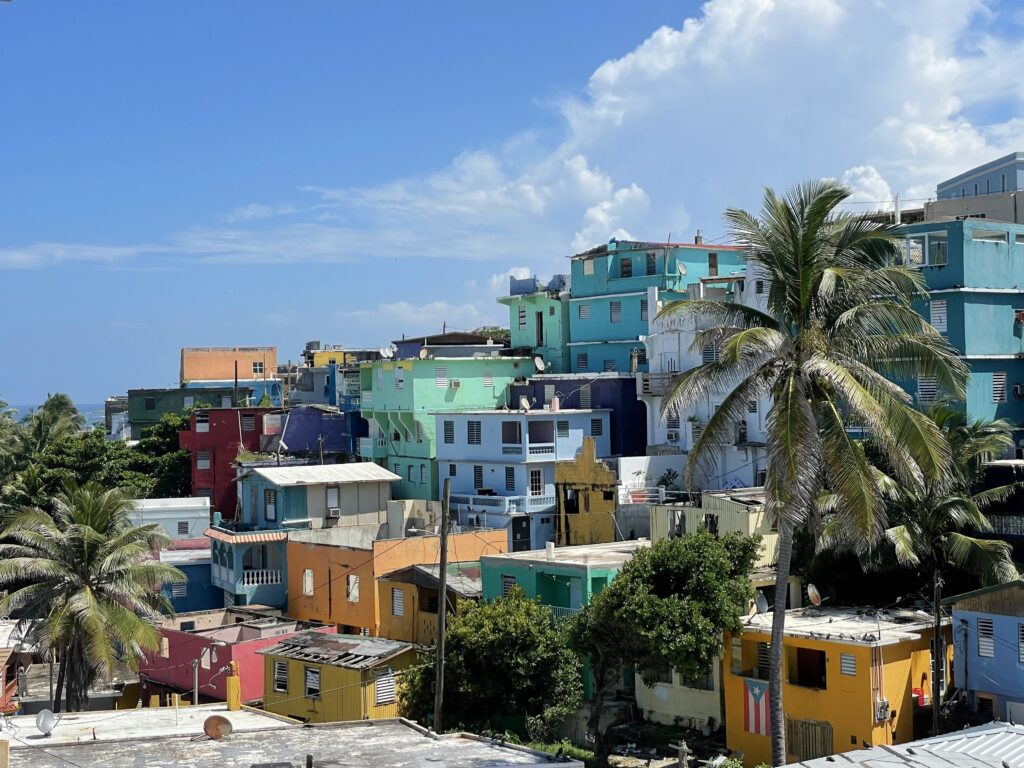
La Perla is the colorful neighborhood you can see from the seawall just outside the north wall of Old San Juan. It’s beautiful from above and it became famous when the “Despacito” video was filmed there. People come to Puerto Rico now thinking they’re visiting the set of a music video.
They aren’t. They’re visiting a real place with real people who live there and don’t owe anyone a photograph. Residents do not generally like tourists wandering around with cameras out, and they especially don’t like it at night. Walking into La Perla at night is not safe and I’d never recommend it to a visitor. Even in the daytime, I wouldn’t suggest going either.
I’ve been there once, in the daytime, with my brother-in-law who lives in Puerto Rico and is street-smart in the way you have to be. I would not go alone with my husband. He has an international look about him, but standing next to me, he reads less like a local. Context matters.
My honest advice is to view La Perla from the seawall above Old San Juan, take a photo from there if you want one, appreciate that real people are living their lives down there, and move on. It’s not a tourist attraction. It just looks like one in pictures.
What actually goes wrong for tourists
The official Puerto Rico homicide rate is not the relevant statistic for most visitors. The relevant statistics are the boring, opportunistic kinds of crime that happen everywhere there are tourists with belongings:
- Theft from parked rental cars, especially anywhere near a popular beach or trailhead. Don’t leave anything visible. Better yet, don’t leave anything in the car at all.
- Pickpocketing in crowded tourist areas, mostly in Old San Juan and on busy nightlife streets. (This is never happened to me or anyone I know.)
- The occasional taxi or rental car scam. Use Uber or official airport taxis. Photograph your rental car before you drive off the lot.
The other thing locals will tell you, and that I’ll tell you too, is that the biggest day-to-day risk is the driving. Puerto Rican drivers can be aggressive. People treat red lights as stop signs. People stop in the middle of the road for no reason. People pass on the right at speed. Drive defensively, especially in metro San Juan. See my post about driving in Puerto Rico.
Where I tell people to be more careful
Most of the island is fine. The places where I’d think twice are specific:
- La Perla is covered above. Don’t go in.
- Public housing complexes (caseríos) anywhere on the island. These are the neighborhoods where most of the violence in those statistics happens. They aren’t on a tourist’s itinerary anyway.
- Loíza Street nightlife in Santurce can be hit or miss. Great food and music, but a few isolated incidents in recent years have made it worth being aware of your surroundings, particularly late at night.
- Driving alone at night in unfamiliar areas. If your GPS is routing you through somewhere that doesn’t feel right, trust that instinct and take a different route. Especially a more populated one.
The hurricane question, briefly
This is the other safety question that people ask. Hurricane season runs June through November, with September and October being the highest-risk months. If you’re traveling in that window, watch the forecast, have a flexible mindset and consider travel insurance. Most years are fine. But hurricanes are the one safety variable in Puerto Rico that’s bigger than it is on the mainland US.
So is Puerto Rico safe?
Yes, for what you’re probably going to do. About as safe as visiting Philadelphia, statistically. Safer than DC. Less safe than New York or Miami. And definitely safer than a lot of other Caribbean destinations on the same shortlist.
The places where it’s not safe are specific places that tourists have no reason to go, where the violence is overwhelmingly between people who know each other and is concentrated in a population you are not part of. The places you actually want to visit — Old San Juan, the beaches, the rainforest, the west coast surf towns, the bioluminescent bay, the mountain towns — are safe in the same way most US tourist destinations are safe. Be reasonably alert, lock your rental car, don’t go wandering into neighborhoods you don’t know at 2am, and you’ll be fine.
If anyone tells you the answer is simpler than that in either direction, they’re selling you something.
Sources: Puerto Rico Institute of Statistics, PRVDRS Annual Summary 2025 · Council on Criminal Justice, Year-End 2025 Update · USAFacts · Wirepoints 2024 city homicide rankings · Discover Puerto Rico 2024 tourism research · Government of Canada Travel Advisories · InSight Crime 2024 Caribbean Homicide Round-Up.
7-Day Puerto Rico Itinerary
Ready to really experience Puerto Rico?
Hear live bomba music on the beach, fall asleep to the coquis in a jungle treehouse, taste Puerto Rican coffee on the farm where it was grown, swim in water that glows when you move through it.
Get the Guide →
Erick was born and raised on the island. Whitney came as an exchange student, fell in love with Puerto Rico and with him, and married into the island for good. Fluent in Spanish, well-traveled across the globe and determined to squeeze every last drop out of a trip, she’s the planner. He knows every back road, every hidden beach and every family-run restaurant worth stopping for. Together they’ve built an itinerary that combines insider local knowledge with the eye of an experienced traveler.